10 Website Changes That Improve Both SEO and AI Search Visibility
Is your website invisible to AI? Most Australian businesses don't know the answer. And that silence is costing them leads every single day.
Most businesses are still focused on traditional SEO best practices and assuming that is enough. It is not. In 2026, AI-powered tools like ChatGPT, Perplexity, and Google's AI Overviews are answering customer questions directly. If your website is not built for AI search visibility, you are being skipped. Completely.
The good news? Most of the changes that improve AI search visibility also strengthen your SEO best practices at the same time. Better content structure, proper schema markup, and smarter search optimisation all work together. Here are 10 website changes you can start with today.
What Is AI Search Visibility and Why Does It Matter?
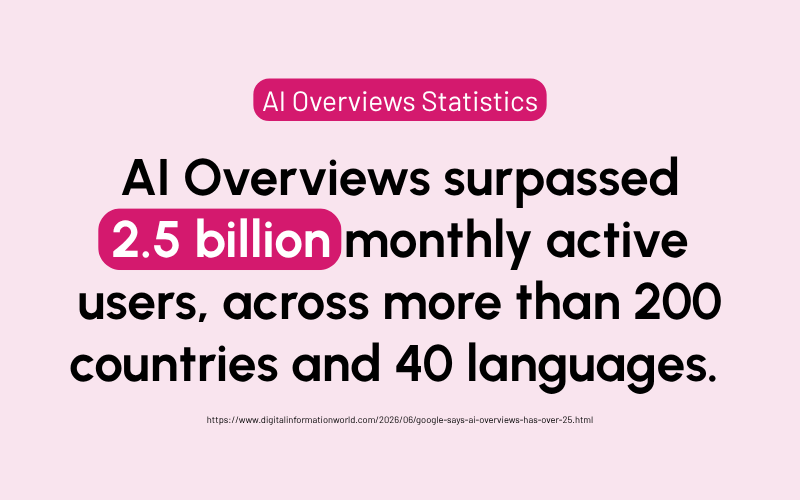
AI search visibility refers to how easily artificial intelligence tools can find, read, and recommend your website content. It goes beyond traditional rankings. It is about whether AI-powered search engines can extract, understand, and surface your content in their responses.
In 2026, AI search tools are handling an increasing share of online queries. Google's AI Overviews, ChatGPT browsing, and Perplexity all pull from websites they can easily read and trust. If your content structure, schema markup, and search optimisation are not in order, AI simply skips your site.
AI search visibility is now a core part of any serious SEO strategy.
Why SEO Best Practices Alone Are No Longer Enough?
Traditional SEO best practices focus on rankings, backlinks, and keyword placement. Those still matter. But AI-powered search works differently. It prioritises:
- Clear, structured answers
- Trustworthy and authoritative content
- Proper schema markup and metadata
- Logical content structure that AI can easily parse
- Fast, accessible, and well-organised websites
Businesses that only follow old-school SEO best practices are leaving AI search visibility on the table. A combined approach is what wins in 2026.
10 Website Changes That Improve Both SEO and AI Search Visibility
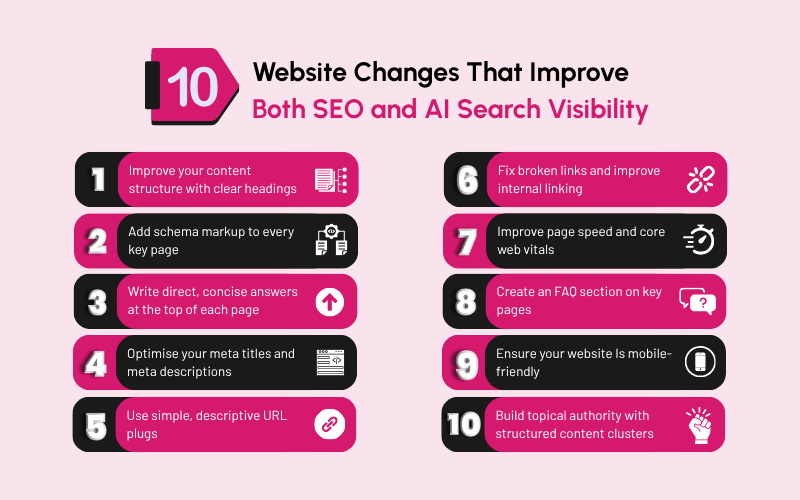
If you want your website to show up in both Google results and AI-generated answers, the good news is you do not need two separate strategies. Most of the changes that improve traditional SEO also make your content easier for AI tools to read, extract, and cite. Here are ten updates worth making:
1. Improve Your Content Structure With Clear Headings
AI tools scan your content structure to understand what a page is about. Use H1, H2, and H3 headings logically. Each heading should answer a clear question or introduce a specific topic.
Good content structure helps Google rank your page. It also helps AI tools extract and cite your content accurately. Both outcomes improve your overall search optimisation.
Quick wins:
- Use one H1 per page
- Break content into logical sections with H2s and H3s
- Make headings descriptive, not clever
2. Add Schema Markup to Every Key Page
Schema markup is structured data that tells search engines exactly what your content means. It is one of the most powerful tools for improving AI search visibility.
When you add schema markup, AI tools can identify your business details, services, FAQs, reviews, and more without guessing. This increases the chance your content appears in AI-generated answers and rich results.
Schema markup types to prioritise:
- Organisation schema
- FAQ schema
- Article schema
- Local Business schema
- Breadcrumb schema
Schema markup is a non-negotiable part of modern SEO best practices. If your site does not have it, add it now.
3. Write Direct, Concise Answers at the Top of Each Page
AI search tools favour content that answers questions immediately. Do not bury your main point three paragraphs in. Lead with the answer, then explain it.
This approach improves AI search visibility by making your content easy to extract and cite. It also supports SEO best practices by targeting featured snippet positions in traditional search.
One clear sentence at the top of each section can dramatically improve your search optimisation results.
4. Optimise Your Meta Titles and Meta Descriptions
Your meta title is the clickable headline in search results. Your meta description is the 160 character summary beneath it. Both are foundational to SEO best practices and AI search visibility.
AI tools read meta data to understand page intent. A well-written meta title and description signal relevance, authority, and clarity.
Best practices:
- Include your primary keyword naturally in the meta title
- Keep meta descriptions at 160 characters
- Write for humans first, search engines second
- Avoid keyword stuffing
Properly written meta data supports both traditional and AI-driven search optimisation.
5. Use Simple, Descriptive URL Slugs
Your slug is the part of a URL that identifies a specific page (e.g., the slug in example.com/SEO-best-practices is SEO-best-practices). A clear, descriptive slug improves both SEO best practices and AI search visibility.
AI tools use URL structure as a relevance signal. A confusing or generic slug reduces your page's chance of being surfaced in AI-generated responses.
Good slug habits:
- Use hyphens between words
- Keep slugs short and descriptive
- Include the primary keyword where natural
- Avoid numbers, dates, and random strings
Clean slugs are a small but meaningful part of smart search optimisation.
6. Fix Broken Links and Improve Internal Linking
Broken links damage your credibility with both Google and AI tools. They signal a poorly maintained website. Fixing them is one of the fastest wins in SEO best practices.
Strong internal linking helps AI tools understand how your content relates to itself. It builds topical authority and improves your overall content structure.
Internal linking tips:
- Link related blog posts and service pages together
- Use descriptive anchor text, not "click here"
- Ensure every important page is reachable within three clicks
- Audit your links regularly
Better internal linking directly supports AI search visibility and search optimisation.
7. Improve Page Speed and Core Web Vitals
Slow websites rank lower. They are also less likely to be crawled and indexed effectively by AI search tools. Page speed is a confirmed Google ranking factor and a core part of modern SEO best practices.
Google's Core Web Vitals measure loading speed, visual stability, and interactivity. Poor scores damage both traditional rankings and AI search visibility.
Quick improvements:
- Compress and properly size all images
- Minimise unnecessary scripts and plugins
- Use a reliable hosting provider
- Enable browser caching
Fast websites support better search optimisation across every channel.
8. Create an FAQ Section on Key Pages
FAQ sections are one of the best investments for AI search visibility. They directly match the conversational, question-based format that AI tools use to find answers.
A well-structured FAQ also qualifies for FAQ schema markup, which increases your chances of appearing in rich results. It supports content structure, search optimisation, and AI-readiness all at once.
Effective FAQ tips:
- Write questions exactly as your customers ask them
- Keep answers short, clear, and direct
- Add FAQ schema markup to every FAQ section
- Update FAQs regularly as questions evolve
FAQs are a simple, high-impact way to boost AI search visibility.
9. Ensure Your Website Is Mobile-Friendly
More than 60% of searches now happen on mobile devices. Google uses mobile-first indexing, meaning it evaluates the mobile version of your site for rankings. A poor mobile experience directly harms your SEO best practices and AI search visibility.
AI search tools also favour sites that load cleanly and consistently across devices.
Mobile optimisation checklist:
- Use a responsive design that adapts to all screen sizes
- Test your site on multiple devices regularly
- Ensure buttons and links are easy to tap
- Avoid intrusive pop-ups on mobile
Mobile performance is a foundational element of modern search optimisation.
10. Build Topical Authority With Structured Content Clusters
AI search tools favour websites that demonstrate genuine expertise on a topic. One blog post is not enough. You need a network of related, well-structured content that builds topical authority.
Content clusters — a pillar page supported by related blog posts — signal depth and relevance to both Google and AI tools. This is one of the most effective long-term SEO best practices you can invest in.
How to build content clusters:
- Choose a core topic relevant to your business
- Write a comprehensive pillar page covering the topic broadly
- Create supporting blog posts targeting specific subtopics
- Link all cluster content back to the pillar page
- Use consistent schema markup and content structure throughout
Strong content clusters are a proven driver of AI search visibility and lasting search optimisation results.
Make Your Website Visible to Both Google and AI
AI search visibility is not a future problem. It is happening right now. Every day your website is not optimised for AI search, you are handing potential leads to competitors who are. The 10 changes above are not complicated. They are practical, proven, and they work for both traditional SEO best practices and AI-powered search at the same time. Better content structure, proper schema markup, and smarter search optimisation are all within reach. The only thing left is to start.
At Elephant in the Boardroom, we help Australian businesses close the gap between where their website is and where it needs to be. From schema markup and content structure to full search optimisation strategies built for AI search visibility, we do the work that actually moves the needle. Contact us today and let's make sure your website gets found by Google and by AI.

Dianna is Content and Social Media Lead at Elephant in the Boardroom Philippines, where she leads content strategy and management, brand direction, and social performance across multiple brands. With strong experience in digital content marketing and audience engagement, she brings expertise in brand storytelling, platform optimisation, and campaign execution. She contributes insights on content strategy, social growth, and digital communications, drawing on experience working with regional and global marketing teams.