ChatGPT Ads vs Meta Ads vs Google Ads: Full Comparison
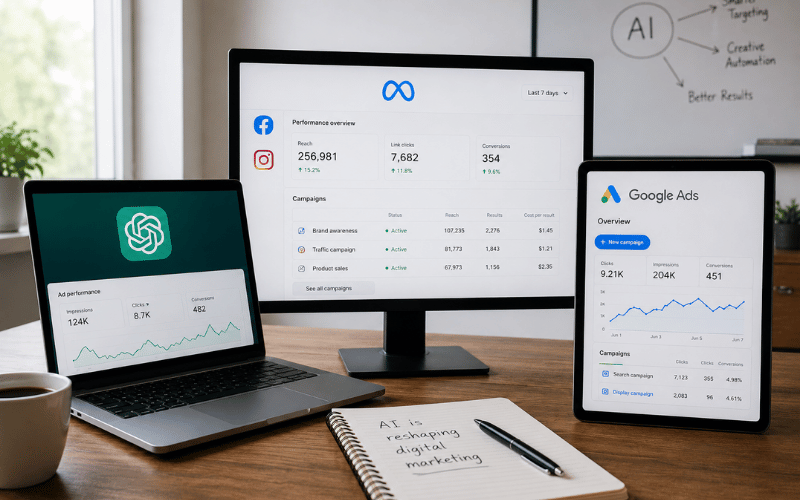
Google gets the credit. Meta gets the budget. ChatGPT gets the sale.
That's the uncomfortable reality playing out right now in AI digital marketing. Customers are asking ChatGPT what to buy, getting a straight answer, and converting, all before Google serves a single ad or Meta finishes loading a reel.
Three platforms. Three completely different ways your money works, or doesn't. This breakdown tells you exactly which one deserves your next campaign budget.
What’s Inside:
- The Rise of AI Digital Marketing: How Advertising is Evolving in 2026
- ChatGPT Ads vs Meta Ads vs Google Ads: Key Differences Explained
- Which Advertising Platform Is Best for Your Business Goals?
- Get the Right Ads Running on the Right Platform Today
The Rise of AI Digital Marketing: How Advertising is Evolving in 2026
AI is now shaping how advertising works at every stage, from how audiences are identified to how campaigns are delivered and optimised. In 2026, the key shift is not just automation, but how different platforms use AI to influence user decisions across ChatGPT Ads vs Meta Ads vs Google Ads.
Each platform is evolving with a distinct strength:
- Google Ads focuses on capturing existing search intent
- Meta Ads focuses on building attention and behavioural targeting
- ChatGPT-style ads are emerging around conversational discovery and guided decision-making
This shift is pushing advertisers to think less about channels in isolation and more about how AI interprets intent across different environments in AI digital marketing.
AI-Powered Audience Targeting
AI now helps advertisers reach users based on predictive intent rather than static demographics.
- Identifies users based on likely interest and behaviour signals
- Connects data across platforms for improved reach accuracy
- Reduces reliance on manual audience segmentation
Smarter Ad Personalisation
Personalisation is increasingly dynamic, adjusting content based on real-time signals.
- Messaging adapts to user behaviour and engagement patterns
- Content variations are automatically generated for relevance
- Ads feel more contextual across different touchpoints
Automated Campaign Optimisation
Campaign management is shifting towards continuous AI-led optimisation.
- Budget distribution adjusts based on performance signals
- Bidding strategies evolve automatically in real time
- Testing happens at scale with minimal manual input
Conversational Advertising Is Growing
A new format of advertising is emerging around natural language interaction.
- Users engage through questions instead of keywords
- AI systems guide product discovery in real time
- Advertising blends into conversational experiences
Creative Production Is Faster
AI is reducing the time needed to produce and test ad creatives.
- Faster generation of copy and visual assets
- Easy adaptation across platforms and formats
- More testing cycles driven by performance data
ChatGPT Ads vs Meta Ads vs Google Ads: Key Differences Explained
To understand where performance comes from, we need to break down ChatGPT Ads vs Meta Ads vs Google Ads, and how each one approaches user intent, targeting, placement, and conversions in practice.
User Intent
- ChatGPT Ads- Best for people asking direct questions, comparing options or looking for guidance before making a decision. This makes it powerful for brands that want to appear during research-heavy moments.
- Meta Ads- Best for creating demand. People may not be actively searching, but strong visuals, offers and targeting can capture attention while they scroll.
- Google Ads- Best for high-intent searches. People are already looking for a product, service or solution, which makes it ideal for lead generation and direct conversions.
Ad Placement
- ChatGPT Ads- Ads may appear within conversational experiences, where users are asking questions and expecting helpful answers.
- Meta Ads- Ads appear across Facebook, Instagram, Messenger, Reels, Stories and feeds, making it a strong platform for visual discovery.
- Google Ads- Ads can appear on Search, YouTube, Display, Gmail, Maps and Shopping, depending on campaign type and targeting.
Targeting Style
- ChatGPT Ads- Targeting is more likely to be based on conversation context, user questions and the topic being explored.
- Meta Ads- Targeting is driven by audience behaviour, interests, engagement, lookalikes and AI-powered optimisation.
- Google Ads- Targeting is built around search intent, keywords, audience signals, website data and conversion goals.
Creative Format
- ChatGPT Ads- The creative needs to feel helpful, relevant and natural within a conversational flow. Direct answers and useful positioning matter more than loud visuals.
- Meta Ads- Creative is the main driver. Strong images, videos, hooks and offers are essential because the user is not always looking for you.
- Google Ads- Copy clarity matters most, especially on Search. Headlines, descriptions, landing page relevance and offer strength all influence performance.
Pricing Model
- ChatGPT Ads- Generally positioned as premium inventory with CPM-based pricing, reflecting high-value conversational placements in AI digital marketing environments.
- Meta Ads- Typically use CPM or CPC models depending on campaign objectives, with strong optimisation through automated bidding systems.
- Google Ads- Primarily uses CPC bidding, where advertisers pay per click generated from search queries.
Which Advertising Platform Is Best for Your Business Goals?
There is no single platform that works best for every business. The strongest advertising strategy usually combines multiple channels based on how customers discover, research, and purchase products or services.
Choose ChatGPT Ads If You Want:
- To reach users during the research and discovery stages
- To align your brand with conversational AI experiences
- To build authority through contextual recommendations
- To support educational or solution-based marketing strategies
ChatGPT advertising may become especially valuable for businesses focused on thought leadership, complex services, and trust-driven customer journeys.
Choose Meta Ads If You Want:
- Strong visual storytelling opportunities
- High audience engagement across social platforms
- Powerful retargeting capabilities
- Faster awareness and brand exposure
Meta continues performing well for ecommerce, lifestyle brands, events, hospitality, and visually driven campaigns.
Choose Google Ads If You Want:
- High-intent traffic
- Lead generation opportunities
- Strong conversion-focused campaigns
- Immediate visibility for active searches
Google remains highly effective for service businesses, local businesses, finance, legal, healthcare, and industries where users actively search before making decisions.
Most customers don’t stick to just one platform, they might see your brand on Meta, look it up on ChatGPT, and finally decide through Google Search. That’s why modern marketing works best when everything is connected, with each platform playing its part in building awareness, trust, and helping people eventually convert.
Get the Right Ads Running on the Right Platform Today
Choosing the wrong agency costs more than a bad campaign; it costs you months of lost ground while competitors lock in their audiences. Elephant in the Boardroom isn't just another PPC ads agency Melbourne businesses turn to when results flatline, it's where strategy actually meets execution across Google, Meta, and ChatGPT Ads under one roof.
As one of the top AI digital marketing agencies in Melbourne, the team already knows which platform suits your business, what budget split makes sense, and how to build campaigns that don't need constant fixing. Get in touch with us today.

Candace is Co-Founder and Head of Marketing at Elephant in the Boardroom, where she leads brand, growth, and digital strategy across multi-channel platforms. With over 10 years of experience in digital marketing, web development, and performance strategy, she brings expertise in customer acquisition, conversion optimisation, and data-driven storytelling. She contributes insights on modern marketing, AI-led growth, and digital transformation, drawing on experience working with enterprise-scale organisations and cross-functional global teams.