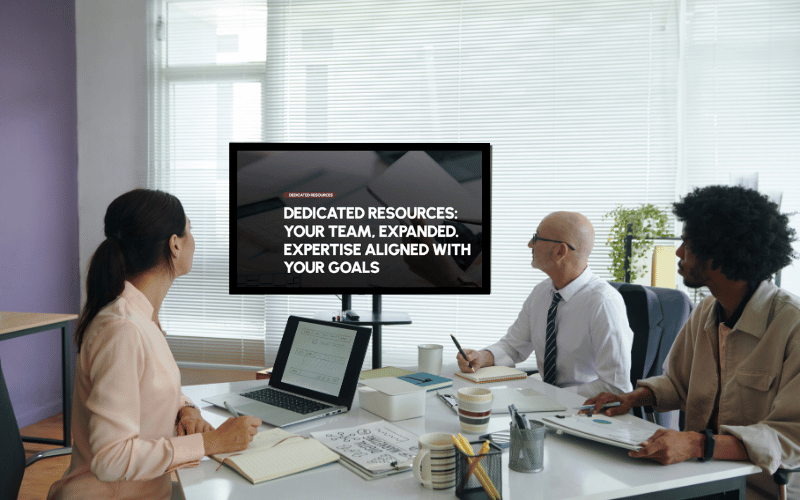
Scale Your Team Without Breaking the Budget: A Guide to Dedicated Resources
Here's a conversation that happens in boardrooms across Australia: the business is growing, the pipeline is full, the team is stretched — and someone says, "We need to hire."
Then the CFO opens a spreadsheet.
A mid-level marketing hire in Melbourne will run you $85,000–$110,000 in base salary before you touch super, annual leave loading, workers' comp, onboarding time, equipment, or the very real chance they're gone in 18 months. A senior developer? Add another $40,000 to that number and a three-month recruitment lag.
Most growing businesses aren't short on ambition. They're short on the right model for resourcing that ambition without blowing the budget before the revenue catches up.
That's exactly where dedicated resources come in — and why more Australian SMEs and scale-ups are rethinking how they build their teams entirely.
What Are Dedicated Resources?
The term gets thrown around a lot, so let's be direct about what it means in practice.
Dedicated resources are professionals — developers, marketers, designers, operations staff, project managers — who work exclusively on your business, under your direction, but are employed and managed through a specialist provider. They're not a freelancer you find on a platform who's juggling six clients at once. They're not a generalist agency running your account between dozens of others.
They're your team. Just not on your payroll.
There are broadly two models worth understanding:
Offshore Dedicated Resources
Your dedicated team is based in a lower-cost talent market like the Philippines and India, but integrated into your workflows, your tools, your culture. Done well, the timezone gap is manageable. Done poorly, it becomes an excuse for poor delivery.
Managed Dedicated Resources
Your provider handles HR, compliance, performance management and infrastructure. You get the output and the relationship. They carry the employment overhead. This is the model that particularly suits businesses that want scale without building an internal people function to support it.
The Real Cost of Hiring in Australia (The Numbers Nobody Puts in the Job Ad)
Let's put some honest figures on the table, because the listed salary is genuinely just the starting point.
For a $90,000 marketing coordinator role in Melbourne, the true annual cost to your business sits closer to $130,000–$145,000 once you account for on-costs, tools, and lost productivity during ramp-up.
Here's where the gap opens up:
- Superannuation: 11.5% on top of base salary
- Annual and personal leave: typically 4–6 weeks of paid non-productive time
- Workers' compensation insurance: 1–2% of payroll depending on industry
- Payroll tax: applies once your Australian wages exceed your state threshold (as low as $700K in some states)
- Recruitment: agency fees run 15–20% of first-year salary; internal recruitment still costs time and advertising spend
- Equipment and software licensing: $3,000–$8,000 upfront per hire
- Onboarding and ramp-up: productivity typically runs at 50–70% for the first 3 months
- Turnover risk: the average Australian employee tenure in digital, marketing and admin roles is under 2.5 years
Now compare that to a dedicated resource model. For a comparable mid-level marketing professional through an offshore dedicated resources arrangement, the monthly investment typically sits between $3,500–$5,500 AUD — fully managed, no super, no leave liability, no recruitment fees.
Annualised, that's $42,000–$66,000 for a role that would cost you $130,000+ locally. The delta is real, and the capability gap, when you work with the right provider, is far smaller than most business owners assume before they try it.
A Scenario Worth Sitting With
Take a Melbourne-based mortgage broking firm. Like most in their space, they were running lean — a small front-of-house team handling client intake, loan processing support, compliance documentation, and general admin. Good people, but expensive to hire locally, hard to retain, and constantly stretched during busy periods.
They came to us not because the business was struggling, but because the principal was tired of the revolving door. Every time someone left, it cost them three months of recruitment, another three months of ramp-up, and a client experience that quietly suffered in between.
They brought on a dedicated offshore admin staff through us, handling loan application coordination, document management, and client follow-up. Client communication turnaround improved, the principal got time back, and the annual saving on having their dedicated support team came in above $60,000 compared to equivalent local hires.
What they'll tell you now isn't just about the cost. It's that the dedicated model brought consistency. The same people, embedded in their process, who actually know the business.
That's what most businesses are really missing when they keep hiring locally and watching people leave.
What Dedicated Resources Let You Do
Beyond the cost argument because for some business owners the cost argument alone isn't enough this model changes what's possible at the growth stage.
- You can staff up for a specific growth phase without locking in permanent overhead
- You can build specialist capability (SEO, paid ads, data analysis, development) that would be out of reach as a local hire at your current revenue
- You can operate across more time zones, which matters in eCommerce, SaaS, and global service businesses
- You can test, fail fast, and reconfigure a team structure without a redundancy conversation and a Fair Work headache
This is what scalable workforce solutions for growing businesses actually look like in practice — not a hiring freeze, not a freelancer patchwork, but a deliberate model for building capability that matches your growth curve.
The Objections (And What's True)
Communication will be a nightmare.
It can be, if the provider doesn't invest in integration. The best dedicated resource arrangements run in your Slack, your project management tools, your weekly standups. We've seen offshore team members who are more engaged and responsive than local hires who were already mentally checking out.
I need someone who understands the Australian market.
For some roles, that's true and local hires remain the right answer for those. For a significant proportion of execution roles in digital marketing, development, design, and operations, the market context can be learned and the skill is transferable. The question worth asking is: does this role need to be local, or do I just assume it does?
I won't have visibility over what they're doing.
With a well-structured managed dedicated resources model, you typically have more visibility than you do over a local hire because output accountability is baked into the engagement from day one. The vague job description that produces vague results doesn't fly.
How to Know If You're Ready to Explore This
You don't need to be a $50M business to make this model work. But there are some indicators that the time is right:
- You're hiring reactively — a role opens, you scramble — rather than building a workforce strategy
- You've identified capability gaps that local recruitment can't fill quickly or affordably
- Your growth rate is outpacing your ability to hire and onboard sustainably
- You're paying for full-time headcount to do part-time workload in specific functions
- You've had turnover in key roles and absorbed the cost more than once
If three or more of those land — it's worth a conversation.
Scale your Team with Elephant in the Boardroom Dedicated Resources
The best-run businesses we work with don't think of dedicated resources as a cost-cutting measure. They think of it as a capability strategy — a deliberate choice about where to invest in local talent versus where to leverage the global talent market intelligently.
The cost of hiring in Australia is high. The cost of getting the model wrong is higher. And the businesses scaling sustainably right now are the ones who figured out that headcount and capability aren't the same thing.
Dedicated resources aren't a workaround. For the right business, at the right stage, they're the right answer.
If you want to understand what that could look like for your team specifically — what roles translate, what the real investment looks like, and what outcomes others in your position have driven — let's talk.