
Globally, AI-powered search platforms now account for 12-15% of total search activity, with projections putting that figure above 28% by 2027. That kind of share does not build gradually over decades. It builds fast, which tells you everything about how quickly people are changing the way they search. Inside Google alone, around 47% of searches now include AI Overviews, meaning nearly half of all queries are shaped by AI-generated responses before a user even clicks a link.
Australia is not sitting this one out. Nearly half of Australians have used generative AI in the past year, and 41% of Australian SMEs are already putting AI tools to work in their businesses. That is not a tech trend. That is mainstream behaviour.
This is where the conversation around AI visibility, content structure, authority, and working with an AI SEO agency starts to matter. Not as a buzzword, but as a practical way to make sure your business shows up where buyers are now searching.
What’s Inside:
- What Are AI Search Platforms?
- Why Does AI Search Matter for Lead Generation?
- How Do AI Search Platforms Choose Which Businesses to Show?
- How Can Businesses Generate Leads Through AI Search?
- Why Work With an AI SEO Agency?
- Elephant in the Boardroom: Your AI SEO Agency for Smarter Lead Generation
What Are AI Search Platforms?
AI search platforms use artificial intelligence to deliver conversational answers instead of traditional search result pages. They analyse content from multiple sources, summarise information and provide direct responses based on user intent.
For example, instead of searching: SEO agency Melbourne
A user may ask: Which agency offers the best AI SEO solutions in Melbourne for lead generation?
This shift is changing how people discover businesses online. Many users now receive answers directly inside AI-generated results without needing to click multiple websites. This is often called zero-click search.
As a result, businesses need content that answers real customer questions clearly, accurately and confidently, not just content designed around short keywords.
This has also led to the rise of:
- AEO (Answer Engine Optimisation)- optimising content so search engines and AI assistants can easily extract and present direct answers.
- GEO (Generative Engine Optimisation)- optimising content specifically for AI-generated search experiences such as ChatGPT, Google AI Overviews and Perplexity.
Modern SEO is no longer just about rankings. It is about becoming the most trusted and useful answer.
Why Does AI Search Matter for Lead Generation?
AI search matters because customers may make decisions before they ever visit your website.
If your business appears in AI-generated answers, you can build trust earlier in the buyer journey. If your competitors appear and you do not, they may influence the customer before you get the chance.
AI search can help businesses generate leads by:
- Increasing visibility during high-intent research
- Building trust before the website visit
- Supporting branded searches
- Driving more qualified traffic
- Encouraging calls, form submissions and bookings
The goal is not just to rank. The goal is to become the trusted answer when potential customers are ready to act.
How Do AI Search Platforms Choose Which Businesses to Show?
AI search platforms usually favour businesses with clear, helpful, consistent and trustworthy information.
Important visibility signals include:
- Clear service pages
- Helpful FAQs
- Consistent business details online
- Google reviews and testimonials
- Case studies and client results
- Author bios and team expertise
- Fresh, accurate content
- Strong topical authority
- Structured data and schema markup
- Mentions on trusted third-party websites
This is why AI search optimisation needs more than basic SEO. It requires content clarity, technical structure, brand authority and proof.
How Can Businesses Generate Leads Through AI Search?
To generate leads through AI search, your business needs to create content that answers questions, proves credibility and guides users towards enquiry.
Optimise for Conversational Queries
Write content in natural language that mirrors how people interact with AI-generated answers and search assistants. Users search with full questions such as “How do I improve local SEO?” or “What are the best accounting platforms for small businesses?”
Place concise answers near the top of each page, then expand with supporting detail, examples, and CTAs. This structure improves visibility in AI-generated answers while directing qualified users to your website.
Focus on Search Intent
Successful AI search optimization targets intent, not just keywords. Create content that aligns with each stage of the buyer journey:
- Informational- educational guides and FAQs
- Comparative- case studies and service comparisons
- Transactional- service pages and enquiry-focused landing pages
Clear CTAs help convert AI-driven traffic into leads.
Create Answer-First Content
AI systems prioritise content that is easy to extract and understand. Use:
- Direct summaries at the beginning of pages
- Clear headings and subheadings
- Bullet points and concise paragraphs
- Structured FAQs and schema markup
This format improves readability for both users and AI search systems.
Build Conversational FAQs
FAQ pages are highly effective for AI SEO solutions in Melbourne because they align with conversational search behaviour. Address common customer questions, objections, pricing concerns, and next steps in a clear, direct format.
Include enquiry forms, booking links, or contact prompts throughout FAQ sections to reduce friction and increase conversions.
Strengthen Authority with Proof
Trust signals improve visibility and conversion rates. Publish:
- Case studies with measurable outcomes
- Client testimonials and reviews
- Performance metrics and success summaries
Well-structured proof content helps AI systems identify your business as a credible source.
Improve Conversion Pathways
Visibility alone does not generate leads. Your website should include:
- Clear calls to action
- Simple enquiry forms
- Booking or consultation links
- CRM and email automation integrations
Strong conversion pathways ensure traffic from AI-generated answers turns into qualified enquiries.
Continuously Refine Performance
Monitor impressions, clicks, and conversions through analytics and search console data to identify high-performing topics and emerging search trends.
Regularly update pages, expand FAQs, and refine content structure to maintain visibility and improve lead generation over time.
Why Work With an AI SEO Agency?
An AI SEO agency helps businesses prepare for how customers search today, across Google, AI platforms, local results and conversational search.
At Elephant in the Boardroom, we deliver AI search optimisation strategies designed to help businesses become more visible, trusted and ready to generate leads from the future of search.
Our AI SEO solutions in Melbourne can help with:
- AI search visibility audits
- SEO content strategy
- Service page optimisation
- FAQ development
- Schema markup
- Local SEO
- Google Business Profile optimisation
- Authority building
- Conversion-focused landing pages
- GA4 and lead tracking
Elephant in the Boardroom: Your AI SEO Agency for Smarter Lead Generation
Whether you want to generate more qualified leads, strengthen your presence across AI search platforms, or future-proof your digital marketing, our team can help you move from being found to being chosen.
Contact Elephant in the Boardroom today, and let’s build a lead generation strategy that works harder, thinks smarter and keeps your business ahead of the curve.
Globally, AI-powered search platforms now account for 12-15% of total search activity, with projections putting that figure above 28% by 2027. That kind of share does not build gradually over decades. It builds fast, which tells you everything about how quickly people are changing the way they search. Inside Google alone, around 47% of searches now include AI Overviews, meaning nearly half of all queries are shaped by AI-generated responses before a user even clicks a link.
Australia is not sitting this one out. Nearly half of Australians have used generative AI in the past year, and 41% of Australian SMEs are already putting AI tools to work in their businesses. That is not a tech trend. That is mainstream behaviour.
This is where the conversation around AI visibility, content structure, authority, and working with an AI SEO agency starts to matter. Not as a buzzword, but as a practical way to make sure your business shows up where buyers are now searching.
What’s Inside:
- What Are AI Search Platforms?
- Why Does AI Search Matter for Lead Generation?
- How Do AI Search Platforms Choose Which Businesses to Show?
- How Can Businesses Generate Leads Through AI Search?
- Why Work With an AI SEO Agency?
- Elephant in the Boardroom: Your AI SEO Agency for Smarter Lead Generation
What Are AI Search Platforms?
AI search platforms use artificial intelligence to deliver conversational answers instead of traditional search result pages. They analyse content from multiple sources, summarise information and provide direct responses based on user intent.
For example, instead of searching: SEO agency Melbourne
A user may ask: Which agency offers the best AI SEO solutions in Melbourne for lead generation?
This shift is changing how people discover businesses online. Many users now receive answers directly inside AI-generated results without needing to click multiple websites. This is often called zero-click search.
As a result, businesses need content that answers real customer questions clearly, accurately and confidently, not just content designed around short keywords.
This has also led to the rise of:
- AEO (Answer Engine Optimisation)- optimising content so search engines and AI assistants can easily extract and present direct answers.
- GEO (Generative Engine Optimisation)- optimising content specifically for AI-generated search experiences such as ChatGPT, Google AI Overviews and Perplexity.
Modern SEO is no longer just about rankings. It is about becoming the most trusted and useful answer.
Why Does AI Search Matter for Lead Generation?
AI search matters because customers may make decisions before they ever visit your website.
If your business appears in AI-generated answers, you can build trust earlier in the buyer journey. If your competitors appear and you do not, they may influence the customer before you get the chance.
AI search can help businesses generate leads by:
- Increasing visibility during high-intent research
- Building trust before the website visit
- Supporting branded searches
- Driving more qualified traffic
- Encouraging calls, form submissions and bookings
The goal is not just to rank. The goal is to become the trusted answer when potential customers are ready to act.
How Do AI Search Platforms Choose Which Businesses to Show?
AI search platforms usually favour businesses with clear, helpful, consistent and trustworthy information.
Important visibility signals include:
- Clear service pages
- Helpful FAQs
- Consistent business details online
- Google reviews and testimonials
- Case studies and client results
- Author bios and team expertise
- Fresh, accurate content
- Strong topical authority
- Structured data and schema markup
- Mentions on trusted third-party websites
This is why AI search optimisation needs more than basic SEO. It requires content clarity, technical structure, brand authority and proof.
How Can Businesses Generate Leads Through AI Search?
To generate leads through AI search, your business needs to create content that answers questions, proves credibility and guides users towards enquiry.
Optimise for Conversational Queries
Write content in natural language that mirrors how people interact with AI-generated answers and search assistants. Users search with full questions such as “How do I improve local SEO?” or “What are the best accounting platforms for small businesses?”
Place concise answers near the top of each page, then expand with supporting detail, examples, and CTAs. This structure improves visibility in AI-generated answers while directing qualified users to your website.
Focus on Search Intent
Successful AI search optimization targets intent, not just keywords. Create content that aligns with each stage of the buyer journey:
- Informational- educational guides and FAQs
- Comparative- case studies and service comparisons
- Transactional- service pages and enquiry-focused landing pages
Clear CTAs help convert AI-driven traffic into leads.
Create Answer-First Content
AI systems prioritise content that is easy to extract and understand. Use:
- Direct summaries at the beginning of pages
- Clear headings and subheadings
- Bullet points and concise paragraphs
- Structured FAQs and schema markup
This format improves readability for both users and AI search systems.
Build Conversational FAQs
FAQ pages are highly effective for AI SEO solutions in Melbourne because they align with conversational search behaviour. Address common customer questions, objections, pricing concerns, and next steps in a clear, direct format.
Include enquiry forms, booking links, or contact prompts throughout FAQ sections to reduce friction and increase conversions.
Strengthen Authority with Proof
Trust signals improve visibility and conversion rates. Publish:
- Case studies with measurable outcomes
- Client testimonials and reviews
- Performance metrics and success summaries
Well-structured proof content helps AI systems identify your business as a credible source.
Improve Conversion Pathways
Visibility alone does not generate leads. Your website should include:
- Clear calls to action
- Simple enquiry forms
- Booking or consultation links
- CRM and email automation integrations
Strong conversion pathways ensure traffic from AI-generated answers turns into qualified enquiries.
Continuously Refine Performance
Monitor impressions, clicks, and conversions through analytics and search console data to identify high-performing topics and emerging search trends.
Regularly update pages, expand FAQs, and refine content structure to maintain visibility and improve lead generation over time.
Why Work With an AI SEO Agency?
An AI SEO agency helps businesses prepare for how customers search today, across Google, AI platforms, local results and conversational search.
At Elephant in the Boardroom, we deliver AI search optimisation strategies designed to help businesses become more visible, trusted and ready to generate leads from the future of search.
Our AI SEO solutions in Melbourne can help with:
- AI search visibility audits
- SEO content strategy
- Service page optimisation
- FAQ development
- Schema markup
- Local SEO
- Google Business Profile optimisation
- Authority building
- Conversion-focused landing pages
- GA4 and lead tracking
Elephant in the Boardroom: Your AI SEO Agency for Smarter Lead Generation
Whether you want to generate more qualified leads, strengthen your presence across AI search platforms, or future-proof your digital marketing, our team can help you move from being found to being chosen.
Contact Elephant in the Boardroom today, and let’s build a lead generation strategy that works harder, thinks smarter and keeps your business ahead of the curve.
Globally, AI-powered search platforms now account for 12-15% of total search activity, with projections putting that figure above 28% by 2027. That kind of share does not build gradually over decades. It builds fast, which tells you everything about how quickly people are changing the way they search. Inside Google alone, around 47% of searches now include AI Overviews, meaning nearly half of all queries are shaped by AI-generated responses before a user even clicks a link.
Australia is not sitting this one out. Nearly half of Australians have used generative AI in the past year, and 41% of Australian SMEs are already putting AI tools to work in their businesses. That is not a tech trend. That is mainstream behaviour.
This is where the conversation around AI visibility, content structure, authority, and working with an AI SEO agency starts to matter. Not as a buzzword, but as a practical way to make sure your business shows up where buyers are now searching.
What’s Inside:
- What Are AI Search Platforms?
- Why Does AI Search Matter for Lead Generation?
- How Do AI Search Platforms Choose Which Businesses to Show?
- How Can Businesses Generate Leads Through AI Search?
- Why Work With an AI SEO Agency?
- Elephant in the Boardroom: Your AI SEO Agency for Smarter Lead Generation
What Are AI Search Platforms?
AI search platforms use artificial intelligence to deliver conversational answers instead of traditional search result pages. They analyse content from multiple sources, summarise information and provide direct responses based on user intent.
For example, instead of searching: SEO agency Melbourne
A user may ask: Which agency offers the best AI SEO solutions in Melbourne for lead generation?
This shift is changing how people discover businesses online. Many users now receive answers directly inside AI-generated results without needing to click multiple websites. This is often called zero-click search.
As a result, businesses need content that answers real customer questions clearly, accurately and confidently, not just content designed around short keywords.
This has also led to the rise of:
- AEO (Answer Engine Optimisation)- optimising content so search engines and AI assistants can easily extract and present direct answers.
- GEO (Generative Engine Optimisation)- optimising content specifically for AI-generated search experiences such as ChatGPT, Google AI Overviews and Perplexity.
Modern SEO is no longer just about rankings. It is about becoming the most trusted and useful answer.
Why Does AI Search Matter for Lead Generation?
AI search matters because customers may make decisions before they ever visit your website.
If your business appears in AI-generated answers, you can build trust earlier in the buyer journey. If your competitors appear and you do not, they may influence the customer before you get the chance.
AI search can help businesses generate leads by:
- Increasing visibility during high-intent research
- Building trust before the website visit
- Supporting branded searches
- Driving more qualified traffic
- Encouraging calls, form submissions and bookings
The goal is not just to rank. The goal is to become the trusted answer when potential customers are ready to act.
How Do AI Search Platforms Choose Which Businesses to Show?
AI search platforms usually favour businesses with clear, helpful, consistent and trustworthy information.
Important visibility signals include:
- Clear service pages
- Helpful FAQs
- Consistent business details online
- Google reviews and testimonials
- Case studies and client results
- Author bios and team expertise
- Fresh, accurate content
- Strong topical authority
- Structured data and schema markup
- Mentions on trusted third-party websites
This is why AI search optimisation needs more than basic SEO. It requires content clarity, technical structure, brand authority and proof.
How Can Businesses Generate Leads Through AI Search?
To generate leads through AI search, your business needs to create content that answers questions, proves credibility and guides users towards enquiry.
Optimise for Conversational Queries
Write content in natural language that mirrors how people interact with AI-generated answers and search assistants. Users search with full questions such as “How do I improve local SEO?” or “What are the best accounting platforms for small businesses?”
Place concise answers near the top of each page, then expand with supporting detail, examples, and CTAs. This structure improves visibility in AI-generated answers while directing qualified users to your website.
Focus on Search Intent
Successful AI search optimization targets intent, not just keywords. Create content that aligns with each stage of the buyer journey:
- Informational- educational guides and FAQs
- Comparative- case studies and service comparisons
- Transactional- service pages and enquiry-focused landing pages
Clear CTAs help convert AI-driven traffic into leads.
Create Answer-First Content
AI systems prioritise content that is easy to extract and understand. Use:
- Direct summaries at the beginning of pages
- Clear headings and subheadings
- Bullet points and concise paragraphs
- Structured FAQs and schema markup
This format improves readability for both users and AI search systems.
Build Conversational FAQs
FAQ pages are highly effective for AI SEO solutions in Melbourne because they align with conversational search behaviour. Address common customer questions, objections, pricing concerns, and next steps in a clear, direct format.
Include enquiry forms, booking links, or contact prompts throughout FAQ sections to reduce friction and increase conversions.
Strengthen Authority with Proof
Trust signals improve visibility and conversion rates. Publish:
- Case studies with measurable outcomes
- Client testimonials and reviews
- Performance metrics and success summaries
Well-structured proof content helps AI systems identify your business as a credible source.
Improve Conversion Pathways
Visibility alone does not generate leads. Your website should include:
- Clear calls to action
- Simple enquiry forms
- Booking or consultation links
- CRM and email automation integrations
Strong conversion pathways ensure traffic from AI-generated answers turns into qualified enquiries.
Continuously Refine Performance
Monitor impressions, clicks, and conversions through analytics and search console data to identify high-performing topics and emerging search trends.
Regularly update pages, expand FAQs, and refine content structure to maintain visibility and improve lead generation over time.
Why Work With an AI SEO Agency?
An AI SEO agency helps businesses prepare for how customers search today, across Google, AI platforms, local results and conversational search.
At Elephant in the Boardroom, we deliver AI search optimisation strategies designed to help businesses become more visible, trusted and ready to generate leads from the future of search.
Our AI SEO solutions in Melbourne can help with:
- AI search visibility audits
- SEO content strategy
- Service page optimisation
- FAQ development
- Schema markup
- Local SEO
- Google Business Profile optimisation
- Authority building
- Conversion-focused landing pages
- GA4 and lead tracking
Elephant in the Boardroom: Your AI SEO Agency for Smarter Lead Generation
Whether you want to generate more qualified leads, strengthen your presence across AI search platforms, or future-proof your digital marketing, our team can help you move from being found to being chosen.
Contact Elephant in the Boardroom today, and let’s build a lead generation strategy that works harder, thinks smarter and keeps your business ahead of the curve.
Globally, AI-powered search platforms now account for 12-15% of total search activity, with projections putting that figure above 28% by 2027. That kind of share does not build gradually over decades. It builds fast, which tells you everything about how quickly people are changing the way they search. Inside Google alone, around 47% of searches now include AI Overviews, meaning nearly half of all queries are shaped by AI-generated responses before a user even clicks a link.
Australia is not sitting this one out. Nearly half of Australians have used generative AI in the past year, and 41% of Australian SMEs are already putting AI tools to work in their businesses. That is not a tech trend. That is mainstream behaviour.
This is where the conversation around AI visibility, content structure, authority, and working with an AI SEO agency starts to matter. Not as a buzzword, but as a practical way to make sure your business shows up where buyers are now searching.
What’s Inside:
- What Are AI Search Platforms?
- Why Does AI Search Matter for Lead Generation?
- How Do AI Search Platforms Choose Which Businesses to Show?
- How Can Businesses Generate Leads Through AI Search?
- Why Work With an AI SEO Agency?
- Elephant in the Boardroom: Your AI SEO Agency for Smarter Lead Generation
What Are AI Search Platforms?
AI search platforms use artificial intelligence to deliver conversational answers instead of traditional search result pages. They analyse content from multiple sources, summarise information and provide direct responses based on user intent.
For example, instead of searching: SEO agency Melbourne
A user may ask: Which agency offers the best AI SEO solutions in Melbourne for lead generation?
This shift is changing how people discover businesses online. Many users now receive answers directly inside AI-generated results without needing to click multiple websites. This is often called zero-click search.
As a result, businesses need content that answers real customer questions clearly, accurately and confidently, not just content designed around short keywords.
This has also led to the rise of:
- AEO (Answer Engine Optimisation)- optimising content so search engines and AI assistants can easily extract and present direct answers.
- GEO (Generative Engine Optimisation)- optimising content specifically for AI-generated search experiences such as ChatGPT, Google AI Overviews and Perplexity.
Modern SEO is no longer just about rankings. It is about becoming the most trusted and useful answer.
Why Does AI Search Matter for Lead Generation?
AI search matters because customers may make decisions before they ever visit your website.
If your business appears in AI-generated answers, you can build trust earlier in the buyer journey. If your competitors appear and you do not, they may influence the customer before you get the chance.
AI search can help businesses generate leads by:
- Increasing visibility during high-intent research
- Building trust before the website visit
- Supporting branded searches
- Driving more qualified traffic
- Encouraging calls, form submissions and bookings
The goal is not just to rank. The goal is to become the trusted answer when potential customers are ready to act.
How Do AI Search Platforms Choose Which Businesses to Show?
AI search platforms usually favour businesses with clear, helpful, consistent and trustworthy information.
Important visibility signals include:
- Clear service pages
- Helpful FAQs
- Consistent business details online
- Google reviews and testimonials
- Case studies and client results
- Author bios and team expertise
- Fresh, accurate content
- Strong topical authority
- Structured data and schema markup
- Mentions on trusted third-party websites
This is why AI search optimisation needs more than basic SEO. It requires content clarity, technical structure, brand authority and proof.
How Can Businesses Generate Leads Through AI Search?
To generate leads through AI search, your business needs to create content that answers questions, proves credibility and guides users towards enquiry.
Optimise for Conversational Queries
Write content in natural language that mirrors how people interact with AI-generated answers and search assistants. Users search with full questions such as “How do I improve local SEO?” or “What are the best accounting platforms for small businesses?”
Place concise answers near the top of each page, then expand with supporting detail, examples, and CTAs. This structure improves visibility in AI-generated answers while directing qualified users to your website.
Focus on Search Intent
Successful AI search optimization targets intent, not just keywords. Create content that aligns with each stage of the buyer journey:
- Informational- educational guides and FAQs
- Comparative- case studies and service comparisons
- Transactional- service pages and enquiry-focused landing pages
Clear CTAs help convert AI-driven traffic into leads.
Create Answer-First Content
AI systems prioritise content that is easy to extract and understand. Use:
- Direct summaries at the beginning of pages
- Clear headings and subheadings
- Bullet points and concise paragraphs
- Structured FAQs and schema markup
This format improves readability for both users and AI search systems.
Build Conversational FAQs
FAQ pages are highly effective for AI SEO solutions in Melbourne because they align with conversational search behaviour. Address common customer questions, objections, pricing concerns, and next steps in a clear, direct format.
Include enquiry forms, booking links, or contact prompts throughout FAQ sections to reduce friction and increase conversions.
Strengthen Authority with Proof
Trust signals improve visibility and conversion rates. Publish:
- Case studies with measurable outcomes
- Client testimonials and reviews
- Performance metrics and success summaries
Well-structured proof content helps AI systems identify your business as a credible source.
Improve Conversion Pathways
Visibility alone does not generate leads. Your website should include:
- Clear calls to action
- Simple enquiry forms
- Booking or consultation links
- CRM and email automation integrations
Strong conversion pathways ensure traffic from AI-generated answers turns into qualified enquiries.
Continuously Refine Performance
Monitor impressions, clicks, and conversions through analytics and search console data to identify high-performing topics and emerging search trends.
Regularly update pages, expand FAQs, and refine content structure to maintain visibility and improve lead generation over time.
Why Work With an AI SEO Agency?
An AI SEO agency helps businesses prepare for how customers search today, across Google, AI platforms, local results and conversational search.
At Elephant in the Boardroom, we deliver AI search optimisation strategies designed to help businesses become more visible, trusted and ready to generate leads from the future of search.
Our AI SEO solutions in Melbourne can help with:
- AI search visibility audits
- SEO content strategy
- Service page optimisation
- FAQ development
- Schema markup
- Local SEO
- Google Business Profile optimisation
- Authority building
- Conversion-focused landing pages
- GA4 and lead tracking
Elephant in the Boardroom: Your AI SEO Agency for Smarter Lead Generation
Whether you want to generate more qualified leads, strengthen your presence across AI search platforms, or future-proof your digital marketing, our team can help you move from being found to being chosen.
Contact Elephant in the Boardroom today, and let’s build a lead generation strategy that works harder, thinks smarter and keeps your business ahead of the curve.
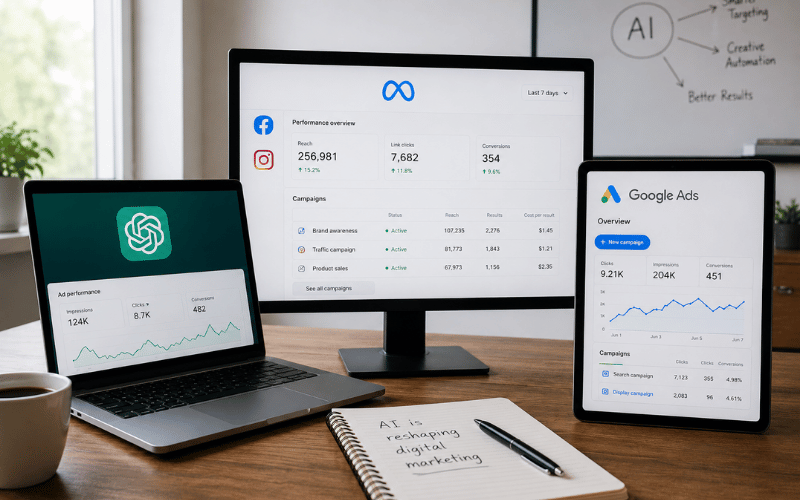
Google gets the credit. Meta gets the budget. ChatGPT gets the sale.
That's the uncomfortable reality playing out right now in AI digital marketing. Customers are asking ChatGPT what to buy, getting a straight answer, and converting, all before Google serves a single ad or Meta finishes loading a reel.
Three platforms. Three completely different ways your money works, or doesn't. This breakdown tells you exactly which one deserves your next campaign budget.
What’s Inside:
- The Rise of AI Digital Marketing: How Advertising is Evolving in 2026
- ChatGPT Ads vs Meta Ads vs Google Ads: Key Differences Explained
- Which Advertising Platform Is Best for Your Business Goals?
- Get the Right Ads Running on the Right Platform Today
The Rise of AI Digital Marketing: How Advertising is Evolving in 2026
AI is now shaping how advertising works at every stage, from how audiences are identified to how campaigns are delivered and optimised. In 2026, the key shift is not just automation, but how different platforms use AI to influence user decisions across ChatGPT Ads vs Meta Ads vs Google Ads.
Each platform is evolving with a distinct strength:
- Google Ads focuses on capturing existing search intent
- Meta Ads focuses on building attention and behavioural targeting
- ChatGPT-style ads are emerging around conversational discovery and guided decision-making
This shift is pushing advertisers to think less about channels in isolation and more about how AI interprets intent across different environments in AI digital marketing.
AI-Powered Audience Targeting
AI now helps advertisers reach users based on predictive intent rather than static demographics.
- Identifies users based on likely interest and behaviour signals
- Connects data across platforms for improved reach accuracy
- Reduces reliance on manual audience segmentation
Smarter Ad Personalisation
Personalisation is increasingly dynamic, adjusting content based on real-time signals.
- Messaging adapts to user behaviour and engagement patterns
- Content variations are automatically generated for relevance
- Ads feel more contextual across different touchpoints
Automated Campaign Optimisation
Campaign management is shifting towards continuous AI-led optimisation.
- Budget distribution adjusts based on performance signals
- Bidding strategies evolve automatically in real time
- Testing happens at scale with minimal manual input
Conversational Advertising Is Growing
A new format of advertising is emerging around natural language interaction.
- Users engage through questions instead of keywords
- AI systems guide product discovery in real time
- Advertising blends into conversational experiences
Creative Production Is Faster
AI is reducing the time needed to produce and test ad creatives.
- Faster generation of copy and visual assets
- Easy adaptation across platforms and formats
- More testing cycles driven by performance data
ChatGPT Ads vs Meta Ads vs Google Ads: Key Differences Explained
To understand where performance comes from, we need to break down ChatGPT Ads vs Meta Ads vs Google Ads, and how each one approaches user intent, targeting, placement, and conversions in practice.
User Intent
- ChatGPT Ads- Best for people asking direct questions, comparing options or looking for guidance before making a decision. This makes it powerful for brands that want to appear during research-heavy moments.
- Meta Ads- Best for creating demand. People may not be actively searching, but strong visuals, offers and targeting can capture attention while they scroll.
- Google Ads- Best for high-intent searches. People are already looking for a product, service or solution, which makes it ideal for lead generation and direct conversions.
Ad Placement
- ChatGPT Ads- Ads may appear within conversational experiences, where users are asking questions and expecting helpful answers.
- Meta Ads- Ads appear across Facebook, Instagram, Messenger, Reels, Stories and feeds, making it a strong platform for visual discovery.
- Google Ads- Ads can appear on Search, YouTube, Display, Gmail, Maps and Shopping, depending on campaign type and targeting.
Targeting Style
- ChatGPT Ads- Targeting is more likely to be based on conversation context, user questions and the topic being explored.
- Meta Ads- Targeting is driven by audience behaviour, interests, engagement, lookalikes and AI-powered optimisation.
- Google Ads- Targeting is built around search intent, keywords, audience signals, website data and conversion goals.
Creative Format
- ChatGPT Ads- The creative needs to feel helpful, relevant and natural within a conversational flow. Direct answers and useful positioning matter more than loud visuals.
- Meta Ads- Creative is the main driver. Strong images, videos, hooks and offers are essential because the user is not always looking for you.
- Google Ads- Copy clarity matters most, especially on Search. Headlines, descriptions, landing page relevance and offer strength all influence performance.
Pricing Model
- ChatGPT Ads- Generally positioned as premium inventory with CPM-based pricing, reflecting high-value conversational placements in AI digital marketing environments.
- Meta Ads- Typically use CPM or CPC models depending on campaign objectives, with strong optimisation through automated bidding systems.
- Google Ads- Primarily uses CPC bidding, where advertisers pay per click generated from search queries.
Which Advertising Platform Is Best for Your Business Goals?
There is no single platform that works best for every business. The strongest advertising strategy usually combines multiple channels based on how customers discover, research, and purchase products or services.
Choose ChatGPT Ads If You Want:
- To reach users during the research and discovery stages
- To align your brand with conversational AI experiences
- To build authority through contextual recommendations
- To support educational or solution-based marketing strategies
ChatGPT advertising may become especially valuable for businesses focused on thought leadership, complex services, and trust-driven customer journeys.
Choose Meta Ads If You Want:
- Strong visual storytelling opportunities
- High audience engagement across social platforms
- Powerful retargeting capabilities
- Faster awareness and brand exposure
Meta continues performing well for ecommerce, lifestyle brands, events, hospitality, and visually driven campaigns.
Choose Google Ads If You Want:
- High-intent traffic
- Lead generation opportunities
- Strong conversion-focused campaigns
- Immediate visibility for active searches
Google remains highly effective for service businesses, local businesses, finance, legal, healthcare, and industries where users actively search before making decisions.
Most customers don’t stick to just one platform, they might see your brand on Meta, look it up on ChatGPT, and finally decide through Google Search. That’s why modern marketing works best when everything is connected, with each platform playing its part in building awareness, trust, and helping people eventually convert.
Get the Right Ads Running on the Right Platform Today
Choosing the wrong agency costs more than a bad campaign; it costs you months of lost ground while competitors lock in their audiences. Elephant in the Boardroom isn't just another PPC ads agency Melbourne businesses turn to when results flatline, it's where strategy actually meets execution across Google, Meta, and ChatGPT Ads under one roof.
As one of the top AI digital marketing agencies in Melbourne, the team already knows which platform suits your business, what budget split makes sense, and how to build campaigns that don't need constant fixing. Get in touch with us today.
Google gets the credit. Meta gets the budget. ChatGPT gets the sale.
That's the uncomfortable reality playing out right now in AI digital marketing. Customers are asking ChatGPT what to buy, getting a straight answer, and converting, all before Google serves a single ad or Meta finishes loading a reel.
Three platforms. Three completely different ways your money works, or doesn't. This breakdown tells you exactly which one deserves your next campaign budget.
What’s Inside:
- The Rise of AI Digital Marketing: How Advertising is Evolving in 2026
- ChatGPT Ads vs Meta Ads vs Google Ads: Key Differences Explained
- Which Advertising Platform Is Best for Your Business Goals?
- Get the Right Ads Running on the Right Platform Today
The Rise of AI Digital Marketing: How Advertising is Evolving in 2026
AI is now shaping how advertising works at every stage, from how audiences are identified to how campaigns are delivered and optimised. In 2026, the key shift is not just automation, but how different platforms use AI to influence user decisions across ChatGPT Ads vs Meta Ads vs Google Ads.
Each platform is evolving with a distinct strength:
- Google Ads focuses on capturing existing search intent
- Meta Ads focuses on building attention and behavioural targeting
- ChatGPT-style ads are emerging around conversational discovery and guided decision-making
This shift is pushing advertisers to think less about channels in isolation and more about how AI interprets intent across different environments in AI digital marketing.
AI-Powered Audience Targeting
AI now helps advertisers reach users based on predictive intent rather than static demographics.
- Identifies users based on likely interest and behaviour signals
- Connects data across platforms for improved reach accuracy
- Reduces reliance on manual audience segmentation
Smarter Ad Personalisation
Personalisation is increasingly dynamic, adjusting content based on real-time signals.
- Messaging adapts to user behaviour and engagement patterns
- Content variations are automatically generated for relevance
- Ads feel more contextual across different touchpoints
Automated Campaign Optimisation
Campaign management is shifting towards continuous AI-led optimisation.
- Budget distribution adjusts based on performance signals
- Bidding strategies evolve automatically in real time
- Testing happens at scale with minimal manual input
Conversational Advertising Is Growing
A new format of advertising is emerging around natural language interaction.
- Users engage through questions instead of keywords
- AI systems guide product discovery in real time
- Advertising blends into conversational experiences
Creative Production Is Faster
AI is reducing the time needed to produce and test ad creatives.
- Faster generation of copy and visual assets
- Easy adaptation across platforms and formats
- More testing cycles driven by performance data
ChatGPT Ads vs Meta Ads vs Google Ads: Key Differences Explained
To understand where performance comes from, we need to break down ChatGPT Ads vs Meta Ads vs Google Ads, and how each one approaches user intent, targeting, placement, and conversions in practice.
User Intent
- ChatGPT Ads- Best for people asking direct questions, comparing options or looking for guidance before making a decision. This makes it powerful for brands that want to appear during research-heavy moments.
- Meta Ads- Best for creating demand. People may not be actively searching, but strong visuals, offers and targeting can capture attention while they scroll.
- Google Ads- Best for high-intent searches. People are already looking for a product, service or solution, which makes it ideal for lead generation and direct conversions.
Ad Placement
- ChatGPT Ads- Ads may appear within conversational experiences, where users are asking questions and expecting helpful answers.
- Meta Ads- Ads appear across Facebook, Instagram, Messenger, Reels, Stories and feeds, making it a strong platform for visual discovery.
- Google Ads- Ads can appear on Search, YouTube, Display, Gmail, Maps and Shopping, depending on campaign type and targeting.
Targeting Style
- ChatGPT Ads- Targeting is more likely to be based on conversation context, user questions and the topic being explored.
- Meta Ads- Targeting is driven by audience behaviour, interests, engagement, lookalikes and AI-powered optimisation.
- Google Ads- Targeting is built around search intent, keywords, audience signals, website data and conversion goals.
Creative Format
- ChatGPT Ads- The creative needs to feel helpful, relevant and natural within a conversational flow. Direct answers and useful positioning matter more than loud visuals.
- Meta Ads- Creative is the main driver. Strong images, videos, hooks and offers are essential because the user is not always looking for you.
- Google Ads- Copy clarity matters most, especially on Search. Headlines, descriptions, landing page relevance and offer strength all influence performance.
Pricing Model
- ChatGPT Ads- Generally positioned as premium inventory with CPM-based pricing, reflecting high-value conversational placements in AI digital marketing environments.
- Meta Ads- Typically use CPM or CPC models depending on campaign objectives, with strong optimisation through automated bidding systems.
- Google Ads- Primarily uses CPC bidding, where advertisers pay per click generated from search queries.
Which Advertising Platform Is Best for Your Business Goals?
There is no single platform that works best for every business. The strongest advertising strategy usually combines multiple channels based on how customers discover, research, and purchase products or services.
Choose ChatGPT Ads If You Want:
- To reach users during the research and discovery stages
- To align your brand with conversational AI experiences
- To build authority through contextual recommendations
- To support educational or solution-based marketing strategies
ChatGPT advertising may become especially valuable for businesses focused on thought leadership, complex services, and trust-driven customer journeys.
Choose Meta Ads If You Want:
- Strong visual storytelling opportunities
- High audience engagement across social platforms
- Powerful retargeting capabilities
- Faster awareness and brand exposure
Meta continues performing well for ecommerce, lifestyle brands, events, hospitality, and visually driven campaigns.
Choose Google Ads If You Want:
- High-intent traffic
- Lead generation opportunities
- Strong conversion-focused campaigns
- Immediate visibility for active searches
Google remains highly effective for service businesses, local businesses, finance, legal, healthcare, and industries where users actively search before making decisions.
Most customers don’t stick to just one platform, they might see your brand on Meta, look it up on ChatGPT, and finally decide through Google Search. That’s why modern marketing works best when everything is connected, with each platform playing its part in building awareness, trust, and helping people eventually convert.
Get the Right Ads Running on the Right Platform Today
Choosing the wrong agency costs more than a bad campaign; it costs you months of lost ground while competitors lock in their audiences. Elephant in the Boardroom isn't just another PPC ads agency Melbourne businesses turn to when results flatline, it's where strategy actually meets execution across Google, Meta, and ChatGPT Ads under one roof.
As one of the top AI digital marketing agencies in Melbourne, the team already knows which platform suits your business, what budget split makes sense, and how to build campaigns that don't need constant fixing. Get in touch with us today.
Google gets the credit. Meta gets the budget. ChatGPT gets the sale.
That's the uncomfortable reality playing out right now in AI digital marketing. Customers are asking ChatGPT what to buy, getting a straight answer, and converting, all before Google serves a single ad or Meta finishes loading a reel.
Three platforms. Three completely different ways your money works, or doesn't. This breakdown tells you exactly which one deserves your next campaign budget.
What’s Inside:
- The Rise of AI Digital Marketing: How Advertising is Evolving in 2026
- ChatGPT Ads vs Meta Ads vs Google Ads: Key Differences Explained
- Which Advertising Platform Is Best for Your Business Goals?
- Get the Right Ads Running on the Right Platform Today
The Rise of AI Digital Marketing: How Advertising is Evolving in 2026
AI is now shaping how advertising works at every stage, from how audiences are identified to how campaigns are delivered and optimised. In 2026, the key shift is not just automation, but how different platforms use AI to influence user decisions across ChatGPT Ads vs Meta Ads vs Google Ads.
Each platform is evolving with a distinct strength:
- Google Ads focuses on capturing existing search intent
- Meta Ads focuses on building attention and behavioural targeting
- ChatGPT-style ads are emerging around conversational discovery and guided decision-making
This shift is pushing advertisers to think less about channels in isolation and more about how AI interprets intent across different environments in AI digital marketing.
AI-Powered Audience Targeting
AI now helps advertisers reach users based on predictive intent rather than static demographics.
- Identifies users based on likely interest and behaviour signals
- Connects data across platforms for improved reach accuracy
- Reduces reliance on manual audience segmentation
Smarter Ad Personalisation
Personalisation is increasingly dynamic, adjusting content based on real-time signals.
- Messaging adapts to user behaviour and engagement patterns
- Content variations are automatically generated for relevance
- Ads feel more contextual across different touchpoints
Automated Campaign Optimisation
Campaign management is shifting towards continuous AI-led optimisation.
- Budget distribution adjusts based on performance signals
- Bidding strategies evolve automatically in real time
- Testing happens at scale with minimal manual input
Conversational Advertising Is Growing
A new format of advertising is emerging around natural language interaction.
- Users engage through questions instead of keywords
- AI systems guide product discovery in real time
- Advertising blends into conversational experiences
Creative Production Is Faster
AI is reducing the time needed to produce and test ad creatives.
- Faster generation of copy and visual assets
- Easy adaptation across platforms and formats
- More testing cycles driven by performance data
ChatGPT Ads vs Meta Ads vs Google Ads: Key Differences Explained
To understand where performance comes from, we need to break down ChatGPT Ads vs Meta Ads vs Google Ads, and how each one approaches user intent, targeting, placement, and conversions in practice.
User Intent
- ChatGPT Ads- Best for people asking direct questions, comparing options or looking for guidance before making a decision. This makes it powerful for brands that want to appear during research-heavy moments.
- Meta Ads- Best for creating demand. People may not be actively searching, but strong visuals, offers and targeting can capture attention while they scroll.
- Google Ads- Best for high-intent searches. People are already looking for a product, service or solution, which makes it ideal for lead generation and direct conversions.
Ad Placement
- ChatGPT Ads- Ads may appear within conversational experiences, where users are asking questions and expecting helpful answers.
- Meta Ads- Ads appear across Facebook, Instagram, Messenger, Reels, Stories and feeds, making it a strong platform for visual discovery.
- Google Ads- Ads can appear on Search, YouTube, Display, Gmail, Maps and Shopping, depending on campaign type and targeting.
Targeting Style
- ChatGPT Ads- Targeting is more likely to be based on conversation context, user questions and the topic being explored.
- Meta Ads- Targeting is driven by audience behaviour, interests, engagement, lookalikes and AI-powered optimisation.
- Google Ads- Targeting is built around search intent, keywords, audience signals, website data and conversion goals.
Creative Format
- ChatGPT Ads- The creative needs to feel helpful, relevant and natural within a conversational flow. Direct answers and useful positioning matter more than loud visuals.
- Meta Ads- Creative is the main driver. Strong images, videos, hooks and offers are essential because the user is not always looking for you.
- Google Ads- Copy clarity matters most, especially on Search. Headlines, descriptions, landing page relevance and offer strength all influence performance.
Pricing Model
- ChatGPT Ads- Generally positioned as premium inventory with CPM-based pricing, reflecting high-value conversational placements in AI digital marketing environments.
- Meta Ads- Typically use CPM or CPC models depending on campaign objectives, with strong optimisation through automated bidding systems.
- Google Ads- Primarily uses CPC bidding, where advertisers pay per click generated from search queries.
Which Advertising Platform Is Best for Your Business Goals?
There is no single platform that works best for every business. The strongest advertising strategy usually combines multiple channels based on how customers discover, research, and purchase products or services.
Choose ChatGPT Ads If You Want:
- To reach users during the research and discovery stages
- To align your brand with conversational AI experiences
- To build authority through contextual recommendations
- To support educational or solution-based marketing strategies
ChatGPT advertising may become especially valuable for businesses focused on thought leadership, complex services, and trust-driven customer journeys.
Choose Meta Ads If You Want:
- Strong visual storytelling opportunities
- High audience engagement across social platforms
- Powerful retargeting capabilities
- Faster awareness and brand exposure
Meta continues performing well for ecommerce, lifestyle brands, events, hospitality, and visually driven campaigns.
Choose Google Ads If You Want:
- High-intent traffic
- Lead generation opportunities
- Strong conversion-focused campaigns
- Immediate visibility for active searches
Google remains highly effective for service businesses, local businesses, finance, legal, healthcare, and industries where users actively search before making decisions.
Most customers don’t stick to just one platform, they might see your brand on Meta, look it up on ChatGPT, and finally decide through Google Search. That’s why modern marketing works best when everything is connected, with each platform playing its part in building awareness, trust, and helping people eventually convert.
Get the Right Ads Running on the Right Platform Today
Choosing the wrong agency costs more than a bad campaign; it costs you months of lost ground while competitors lock in their audiences. Elephant in the Boardroom isn't just another PPC ads agency Melbourne businesses turn to when results flatline, it's where strategy actually meets execution across Google, Meta, and ChatGPT Ads under one roof.
As one of the top AI digital marketing agencies in Melbourne, the team already knows which platform suits your business, what budget split makes sense, and how to build campaigns that don't need constant fixing. Get in touch with us today.
Google gets the credit. Meta gets the budget. ChatGPT gets the sale.
That's the uncomfortable reality playing out right now in AI digital marketing. Customers are asking ChatGPT what to buy, getting a straight answer, and converting, all before Google serves a single ad or Meta finishes loading a reel.
Three platforms. Three completely different ways your money works, or doesn't. This breakdown tells you exactly which one deserves your next campaign budget.
What’s Inside:
- The Rise of AI Digital Marketing: How Advertising is Evolving in 2026
- ChatGPT Ads vs Meta Ads vs Google Ads: Key Differences Explained
- Which Advertising Platform Is Best for Your Business Goals?
- Get the Right Ads Running on the Right Platform Today
The Rise of AI Digital Marketing: How Advertising is Evolving in 2026
AI is now shaping how advertising works at every stage, from how audiences are identified to how campaigns are delivered and optimised. In 2026, the key shift is not just automation, but how different platforms use AI to influence user decisions across ChatGPT Ads vs Meta Ads vs Google Ads.
Each platform is evolving with a distinct strength:
- Google Ads focuses on capturing existing search intent
- Meta Ads focuses on building attention and behavioural targeting
- ChatGPT-style ads are emerging around conversational discovery and guided decision-making
This shift is pushing advertisers to think less about channels in isolation and more about how AI interprets intent across different environments in AI digital marketing.
AI-Powered Audience Targeting
AI now helps advertisers reach users based on predictive intent rather than static demographics.
- Identifies users based on likely interest and behaviour signals
- Connects data across platforms for improved reach accuracy
- Reduces reliance on manual audience segmentation
Smarter Ad Personalisation
Personalisation is increasingly dynamic, adjusting content based on real-time signals.
- Messaging adapts to user behaviour and engagement patterns
- Content variations are automatically generated for relevance
- Ads feel more contextual across different touchpoints
Automated Campaign Optimisation
Campaign management is shifting towards continuous AI-led optimisation.
- Budget distribution adjusts based on performance signals
- Bidding strategies evolve automatically in real time
- Testing happens at scale with minimal manual input
Conversational Advertising Is Growing
A new format of advertising is emerging around natural language interaction.
- Users engage through questions instead of keywords
- AI systems guide product discovery in real time
- Advertising blends into conversational experiences
Creative Production Is Faster
AI is reducing the time needed to produce and test ad creatives.
- Faster generation of copy and visual assets
- Easy adaptation across platforms and formats
- More testing cycles driven by performance data
ChatGPT Ads vs Meta Ads vs Google Ads: Key Differences Explained
To understand where performance comes from, we need to break down ChatGPT Ads vs Meta Ads vs Google Ads, and how each one approaches user intent, targeting, placement, and conversions in practice.
User Intent
- ChatGPT Ads- Best for people asking direct questions, comparing options or looking for guidance before making a decision. This makes it powerful for brands that want to appear during research-heavy moments.
- Meta Ads- Best for creating demand. People may not be actively searching, but strong visuals, offers and targeting can capture attention while they scroll.
- Google Ads- Best for high-intent searches. People are already looking for a product, service or solution, which makes it ideal for lead generation and direct conversions.
Ad Placement
- ChatGPT Ads- Ads may appear within conversational experiences, where users are asking questions and expecting helpful answers.
- Meta Ads- Ads appear across Facebook, Instagram, Messenger, Reels, Stories and feeds, making it a strong platform for visual discovery.
- Google Ads- Ads can appear on Search, YouTube, Display, Gmail, Maps and Shopping, depending on campaign type and targeting.
Targeting Style
- ChatGPT Ads- Targeting is more likely to be based on conversation context, user questions and the topic being explored.
- Meta Ads- Targeting is driven by audience behaviour, interests, engagement, lookalikes and AI-powered optimisation.
- Google Ads- Targeting is built around search intent, keywords, audience signals, website data and conversion goals.
Creative Format
- ChatGPT Ads- The creative needs to feel helpful, relevant and natural within a conversational flow. Direct answers and useful positioning matter more than loud visuals.
- Meta Ads- Creative is the main driver. Strong images, videos, hooks and offers are essential because the user is not always looking for you.
- Google Ads- Copy clarity matters most, especially on Search. Headlines, descriptions, landing page relevance and offer strength all influence performance.
Pricing Model
- ChatGPT Ads- Generally positioned as premium inventory with CPM-based pricing, reflecting high-value conversational placements in AI digital marketing environments.
- Meta Ads- Typically use CPM or CPC models depending on campaign objectives, with strong optimisation through automated bidding systems.
- Google Ads- Primarily uses CPC bidding, where advertisers pay per click generated from search queries.
Which Advertising Platform Is Best for Your Business Goals?
There is no single platform that works best for every business. The strongest advertising strategy usually combines multiple channels based on how customers discover, research, and purchase products or services.
Choose ChatGPT Ads If You Want:
- To reach users during the research and discovery stages
- To align your brand with conversational AI experiences
- To build authority through contextual recommendations
- To support educational or solution-based marketing strategies
ChatGPT advertising may become especially valuable for businesses focused on thought leadership, complex services, and trust-driven customer journeys.
Choose Meta Ads If You Want:
- Strong visual storytelling opportunities
- High audience engagement across social platforms
- Powerful retargeting capabilities
- Faster awareness and brand exposure
Meta continues performing well for ecommerce, lifestyle brands, events, hospitality, and visually driven campaigns.
Choose Google Ads If You Want:
- High-intent traffic
- Lead generation opportunities
- Strong conversion-focused campaigns
- Immediate visibility for active searches
Google remains highly effective for service businesses, local businesses, finance, legal, healthcare, and industries where users actively search before making decisions.
Most customers don’t stick to just one platform, they might see your brand on Meta, look it up on ChatGPT, and finally decide through Google Search. That’s why modern marketing works best when everything is connected, with each platform playing its part in building awareness, trust, and helping people eventually convert.
Get the Right Ads Running on the Right Platform Today
Choosing the wrong agency costs more than a bad campaign; it costs you months of lost ground while competitors lock in their audiences. Elephant in the Boardroom isn't just another PPC ads agency Melbourne businesses turn to when results flatline, it's where strategy actually meets execution across Google, Meta, and ChatGPT Ads under one roof.
As one of the top AI digital marketing agencies in Melbourne, the team already knows which platform suits your business, what budget split makes sense, and how to build campaigns that don't need constant fixing. Get in touch with us today.
Google gets the credit. Meta gets the budget. ChatGPT gets the sale.
That's the uncomfortable reality playing out right now in AI digital marketing. Customers are asking ChatGPT what to buy, getting a straight answer, and converting, all before Google serves a single ad or Meta finishes loading a reel.
Three platforms. Three completely different ways your money works, or doesn't. This breakdown tells you exactly which one deserves your next campaign budget.
What’s Inside:
- The Rise of AI Digital Marketing: How Advertising is Evolving in 2026
- ChatGPT Ads vs Meta Ads vs Google Ads: Key Differences Explained
- Which Advertising Platform Is Best for Your Business Goals?
- Get the Right Ads Running on the Right Platform Today
The Rise of AI Digital Marketing: How Advertising is Evolving in 2026
AI is now shaping how advertising works at every stage, from how audiences are identified to how campaigns are delivered and optimised. In 2026, the key shift is not just automation, but how different platforms use AI to influence user decisions across ChatGPT Ads vs Meta Ads vs Google Ads.
Each platform is evolving with a distinct strength:
- Google Ads focuses on capturing existing search intent
- Meta Ads focuses on building attention and behavioural targeting
- ChatGPT-style ads are emerging around conversational discovery and guided decision-making
This shift is pushing advertisers to think less about channels in isolation and more about how AI interprets intent across different environments in AI digital marketing.
AI-Powered Audience Targeting
AI now helps advertisers reach users based on predictive intent rather than static demographics.
- Identifies users based on likely interest and behaviour signals
- Connects data across platforms for improved reach accuracy
- Reduces reliance on manual audience segmentation
Smarter Ad Personalisation
Personalisation is increasingly dynamic, adjusting content based on real-time signals.
- Messaging adapts to user behaviour and engagement patterns
- Content variations are automatically generated for relevance
- Ads feel more contextual across different touchpoints
Automated Campaign Optimisation
Campaign management is shifting towards continuous AI-led optimisation.
- Budget distribution adjusts based on performance signals
- Bidding strategies evolve automatically in real time
- Testing happens at scale with minimal manual input
Conversational Advertising Is Growing
A new format of advertising is emerging around natural language interaction.
- Users engage through questions instead of keywords
- AI systems guide product discovery in real time
- Advertising blends into conversational experiences
Creative Production Is Faster
AI is reducing the time needed to produce and test ad creatives.
- Faster generation of copy and visual assets
- Easy adaptation across platforms and formats
- More testing cycles driven by performance data
ChatGPT Ads vs Meta Ads vs Google Ads: Key Differences Explained
To understand where performance comes from, we need to break down ChatGPT Ads vs Meta Ads vs Google Ads, and how each one approaches user intent, targeting, placement, and conversions in practice.
User Intent
- ChatGPT Ads- Best for people asking direct questions, comparing options or looking for guidance before making a decision. This makes it powerful for brands that want to appear during research-heavy moments.
- Meta Ads- Best for creating demand. People may not be actively searching, but strong visuals, offers and targeting can capture attention while they scroll.
- Google Ads- Best for high-intent searches. People are already looking for a product, service or solution, which makes it ideal for lead generation and direct conversions.
Ad Placement
- ChatGPT Ads- Ads may appear within conversational experiences, where users are asking questions and expecting helpful answers.
- Meta Ads- Ads appear across Facebook, Instagram, Messenger, Reels, Stories and feeds, making it a strong platform for visual discovery.
- Google Ads- Ads can appear on Search, YouTube, Display, Gmail, Maps and Shopping, depending on campaign type and targeting.
Targeting Style
- ChatGPT Ads- Targeting is more likely to be based on conversation context, user questions and the topic being explored.
- Meta Ads- Targeting is driven by audience behaviour, interests, engagement, lookalikes and AI-powered optimisation.
- Google Ads- Targeting is built around search intent, keywords, audience signals, website data and conversion goals.
Creative Format
- ChatGPT Ads- The creative needs to feel helpful, relevant and natural within a conversational flow. Direct answers and useful positioning matter more than loud visuals.
- Meta Ads- Creative is the main driver. Strong images, videos, hooks and offers are essential because the user is not always looking for you.
- Google Ads- Copy clarity matters most, especially on Search. Headlines, descriptions, landing page relevance and offer strength all influence performance.
Pricing Model
- ChatGPT Ads- Generally positioned as premium inventory with CPM-based pricing, reflecting high-value conversational placements in AI digital marketing environments.
- Meta Ads- Typically use CPM or CPC models depending on campaign objectives, with strong optimisation through automated bidding systems.
- Google Ads- Primarily uses CPC bidding, where advertisers pay per click generated from search queries.
Which Advertising Platform Is Best for Your Business Goals?
There is no single platform that works best for every business. The strongest advertising strategy usually combines multiple channels based on how customers discover, research, and purchase products or services.
Choose ChatGPT Ads If You Want:
- To reach users during the research and discovery stages
- To align your brand with conversational AI experiences
- To build authority through contextual recommendations
- To support educational or solution-based marketing strategies
ChatGPT advertising may become especially valuable for businesses focused on thought leadership, complex services, and trust-driven customer journeys.
Choose Meta Ads If You Want:
- Strong visual storytelling opportunities
- High audience engagement across social platforms
- Powerful retargeting capabilities
- Faster awareness and brand exposure
Meta continues performing well for ecommerce, lifestyle brands, events, hospitality, and visually driven campaigns.
Choose Google Ads If You Want:
- High-intent traffic
- Lead generation opportunities
- Strong conversion-focused campaigns
- Immediate visibility for active searches
Google remains highly effective for service businesses, local businesses, finance, legal, healthcare, and industries where users actively search before making decisions.
Most customers don’t stick to just one platform, they might see your brand on Meta, look it up on ChatGPT, and finally decide through Google Search. That’s why modern marketing works best when everything is connected, with each platform playing its part in building awareness, trust, and helping people eventually convert.
Get the Right Ads Running on the Right Platform Today
Choosing the wrong agency costs more than a bad campaign; it costs you months of lost ground while competitors lock in their audiences. Elephant in the Boardroom isn't just another PPC ads agency Melbourne businesses turn to when results flatline, it's where strategy actually meets execution across Google, Meta, and ChatGPT Ads under one roof.
As one of the top AI digital marketing agencies in Melbourne, the team already knows which platform suits your business, what budget split makes sense, and how to build campaigns that don't need constant fixing. Get in touch with us today.
Google gets the credit. Meta gets the budget. ChatGPT gets the sale.
That's the uncomfortable reality playing out right now in AI digital marketing. Customers are asking ChatGPT what to buy, getting a straight answer, and converting, all before Google serves a single ad or Meta finishes loading a reel.
Three platforms. Three completely different ways your money works, or doesn't. This breakdown tells you exactly which one deserves your next campaign budget.
What’s Inside:
- The Rise of AI Digital Marketing: How Advertising is Evolving in 2026
- ChatGPT Ads vs Meta Ads vs Google Ads: Key Differences Explained
- Which Advertising Platform Is Best for Your Business Goals?
- Get the Right Ads Running on the Right Platform Today
The Rise of AI Digital Marketing: How Advertising is Evolving in 2026
AI is now shaping how advertising works at every stage, from how audiences are identified to how campaigns are delivered and optimised. In 2026, the key shift is not just automation, but how different platforms use AI to influence user decisions across ChatGPT Ads vs Meta Ads vs Google Ads.
Each platform is evolving with a distinct strength:
- Google Ads focuses on capturing existing search intent
- Meta Ads focuses on building attention and behavioural targeting
- ChatGPT-style ads are emerging around conversational discovery and guided decision-making
This shift is pushing advertisers to think less about channels in isolation and more about how AI interprets intent across different environments in AI digital marketing.
AI-Powered Audience Targeting
AI now helps advertisers reach users based on predictive intent rather than static demographics.
- Identifies users based on likely interest and behaviour signals
- Connects data across platforms for improved reach accuracy
- Reduces reliance on manual audience segmentation
Smarter Ad Personalisation
Personalisation is increasingly dynamic, adjusting content based on real-time signals.
- Messaging adapts to user behaviour and engagement patterns
- Content variations are automatically generated for relevance
- Ads feel more contextual across different touchpoints
Automated Campaign Optimisation
Campaign management is shifting towards continuous AI-led optimisation.
- Budget distribution adjusts based on performance signals
- Bidding strategies evolve automatically in real time
- Testing happens at scale with minimal manual input
Conversational Advertising Is Growing
A new format of advertising is emerging around natural language interaction.
- Users engage through questions instead of keywords
- AI systems guide product discovery in real time
- Advertising blends into conversational experiences
Creative Production Is Faster
AI is reducing the time needed to produce and test ad creatives.
- Faster generation of copy and visual assets
- Easy adaptation across platforms and formats
- More testing cycles driven by performance data
ChatGPT Ads vs Meta Ads vs Google Ads: Key Differences Explained
To understand where performance comes from, we need to break down ChatGPT Ads vs Meta Ads vs Google Ads, and how each one approaches user intent, targeting, placement, and conversions in practice.
User Intent
- ChatGPT Ads- Best for people asking direct questions, comparing options or looking for guidance before making a decision. This makes it powerful for brands that want to appear during research-heavy moments.
- Meta Ads- Best for creating demand. People may not be actively searching, but strong visuals, offers and targeting can capture attention while they scroll.
- Google Ads- Best for high-intent searches. People are already looking for a product, service or solution, which makes it ideal for lead generation and direct conversions.
Ad Placement
- ChatGPT Ads- Ads may appear within conversational experiences, where users are asking questions and expecting helpful answers.
- Meta Ads- Ads appear across Facebook, Instagram, Messenger, Reels, Stories and feeds, making it a strong platform for visual discovery.
- Google Ads- Ads can appear on Search, YouTube, Display, Gmail, Maps and Shopping, depending on campaign type and targeting.
Targeting Style
- ChatGPT Ads- Targeting is more likely to be based on conversation context, user questions and the topic being explored.
- Meta Ads- Targeting is driven by audience behaviour, interests, engagement, lookalikes and AI-powered optimisation.
- Google Ads- Targeting is built around search intent, keywords, audience signals, website data and conversion goals.
Creative Format
- ChatGPT Ads- The creative needs to feel helpful, relevant and natural within a conversational flow. Direct answers and useful positioning matter more than loud visuals.
- Meta Ads- Creative is the main driver. Strong images, videos, hooks and offers are essential because the user is not always looking for you.
- Google Ads- Copy clarity matters most, especially on Search. Headlines, descriptions, landing page relevance and offer strength all influence performance.
Pricing Model
- ChatGPT Ads- Generally positioned as premium inventory with CPM-based pricing, reflecting high-value conversational placements in AI digital marketing environments.
- Meta Ads- Typically use CPM or CPC models depending on campaign objectives, with strong optimisation through automated bidding systems.
- Google Ads- Primarily uses CPC bidding, where advertisers pay per click generated from search queries.
Which Advertising Platform Is Best for Your Business Goals?
There is no single platform that works best for every business. The strongest advertising strategy usually combines multiple channels based on how customers discover, research, and purchase products or services.
Choose ChatGPT Ads If You Want:
- To reach users during the research and discovery stages
- To align your brand with conversational AI experiences
- To build authority through contextual recommendations
- To support educational or solution-based marketing strategies
ChatGPT advertising may become especially valuable for businesses focused on thought leadership, complex services, and trust-driven customer journeys.
Choose Meta Ads If You Want:
- Strong visual storytelling opportunities
- High audience engagement across social platforms
- Powerful retargeting capabilities
- Faster awareness and brand exposure
Meta continues performing well for ecommerce, lifestyle brands, events, hospitality, and visually driven campaigns.
Choose Google Ads If You Want:
- High-intent traffic
- Lead generation opportunities
- Strong conversion-focused campaigns
- Immediate visibility for active searches
Google remains highly effective for service businesses, local businesses, finance, legal, healthcare, and industries where users actively search before making decisions.
Most customers don’t stick to just one platform, they might see your brand on Meta, look it up on ChatGPT, and finally decide through Google Search. That’s why modern marketing works best when everything is connected, with each platform playing its part in building awareness, trust, and helping people eventually convert.
Get the Right Ads Running on the Right Platform Today
Choosing the wrong agency costs more than a bad campaign; it costs you months of lost ground while competitors lock in their audiences. Elephant in the Boardroom isn't just another PPC ads agency Melbourne businesses turn to when results flatline, it's where strategy actually meets execution across Google, Meta, and ChatGPT Ads under one roof.
As one of the top AI digital marketing agencies in Melbourne, the team already knows which platform suits your business, what budget split makes sense, and how to build campaigns that don't need constant fixing. Get in touch with us today.

4.4 rating from 30 Google reviews